Why we invested in ATMOS Space Cargo
ATMOS Space Cargo Raises €25.7 Million in Series A to Build Europe’s Orbital Return Infrastructure
The return problem
SpaceX has democratised access to orbit, and several European launcher programmes are working to provide an alternative on the way up. But what Europe has never been able to do, reliably, affordably, on its own terms, is bring things back. ATMOS is changing that.
When ATMOS launched PHOENIX 1 aboard a SpaceX Falcon 9 in April 2025, it became the first European company to achieve orbital re-entry of a commercial capsule. The team designed and flight-qualified the vehicle in under 12 months, on a budget an order of magnitude below cost of comparable programmes. For a space hardware business, that is almost unheard of.
The gap Europe cannot afford to ignore
The International Space Station has, for decades, been the only meaningful platform for microgravity research and manufacturing. It is expensive, constrained, and approaching end of life in 2030. Commercial successors are years away from operation. None of them are European.
Meanwhile, demand is accelerating. Protein crystallisation, drug discovery, semiconductor wafer growth, and fluoride glass manufacturing all benefit enormously from microgravity conditions. Defence agencies across NATO are increasingly focused on sovereign, rapid in-space logistics capabilities for sensitive hardware. The market demand for orbital return logistics is large and growing - and today, almost none of that demand has a viable European option to turn to.
Technology with a real edge
At the core of the ATMOS platform is a proprietary re-entry system that acts simultaneously as heat shield and aerodynamic brake, eliminating the need for a traditional parachute. The result: more payload mass for the same vehicle dimensions, lower g-forces on sensitive cargo, and more precise landing than competing ablative technologies. Better payload-to-mass ratios translate directly into lower prices - a meaningful advantage over the US systems.
A team with the right to win
What struck us about Sebastian is that he didn't follow a conventional path into space. A former German special forces officer turned aerospace engineer, he brings a combination of operational intensity and technical depth that is genuinely unusual in the industry. Around him, Jeffrey brings 20+ years across ESA, Airbus, and JAXA; Marta contributed to the launch of the James Webb Space Telescope; and Christian comes from 12 years at DLR on lunar and asteroid programmes. The credentials speak for themselves - but what matters more is that this team has real conviction about why this needs to exist, and the discipline to build it on a fraction of what comparable programmes have spent.
From demonstration to infrastructure
With Series A funding, ATMOS is moving from demonstration to routine service, with PHOENIX 2 being built as part of a phased operational campaign. A dedicated entity for European governmental and defence customers launches alongside it - anchored by a newly opened office in Kraków, Poland, deepening ATMOS' presence in one of Europe's most strategically important defence markets.
The strategic case for European sovereign return capability is only getting stronger. We are proud to back Sebastian and the team - alongside a European syndicate that shares that conviction - as they build the logistics backbone that Europe's space economy needs.
Full Press Release
ATMOS Space Cargo Raises €25.7 Million in Series A to Build Europe’s Orbital Return Infrastructure
ATMOS Space Cargo, a European company developing orbital transport and re-entry vehicles, has closed a €25.7 million Series A financing round. The funding will support an initial three-vehicle PHOENIX 2 fleet, the launch of ATMOS WORKS for governmental and defence customers, and development of PHOENIX 3, the company’s next-generation orbital return vehicle.
The round is co-led by Balnord and Expansion, and joined by Keen Defence and Security. The European Innovation Council (EIC) participates through its Accelerator programme via blended financing, combining grant and equity components. Additional investors include OTB Ventures, High-Tech Gründerfonds (HTGF), APEX Ventures, Seraphim, Faber, E2MC, Kirch Ventures, Lennertz & Co., Mätch VC, MBG Baden-Württemberg, and Tech Horizons.
PHOENIX 2 Fleet: Three-Flight Campaign
Following its PHOENIX 1 demonstration flight in April 2025, the company is now moving from demonstration to routine operations. Three PHOENIX 2 orbital transfer and return vehicles (OTRVs) will be constructed and operated as a phased operational mission campaign, servicing institutional and commercial clients across a range of payload and mission profiles.
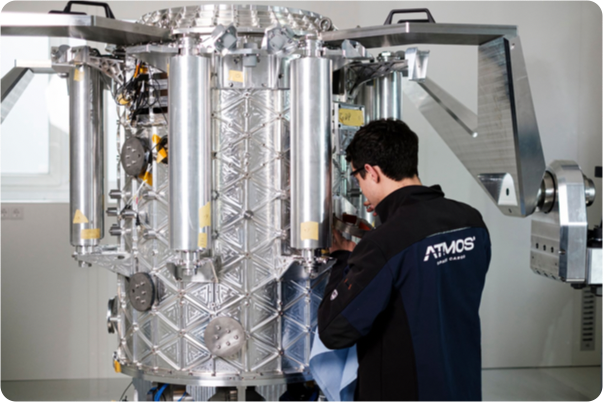
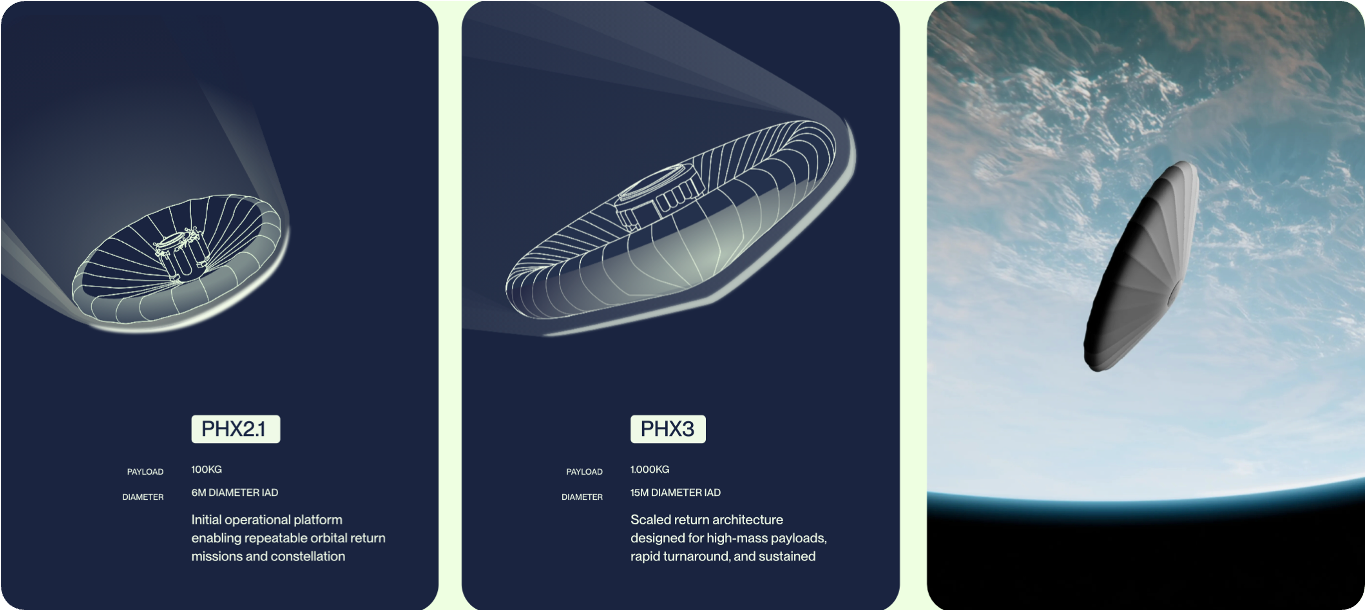
PHOENIX 2 is a free-flying spacecraft equipped with integrated propulsion and power systems, capable of mission durations from hours to several months in Low Earth Orbit (LEO). The vehicle performs autonomous de-orbit, controlled atmospheric re-entry using ATMOS’ Inflatable Atmospheric Decelerator (IAD) technology, which serves as both heat shield and aerodynamic brake. Its non-ablative design minimizes material loss and environmental impact while maximizing payload-to-mass efficiency and re-entry precision for rapid payload recovery.
Initial recovery operations are being prepared near Santa Maria in the Azores, under Portugal’s ANACOM-09/2026-AE licence enabling commercial orbital re-entry operations under a continental European Union member state’s jurisdiction.
The three-flight campaign creates an initial operational cadence, reduces programme risk, and gives research institutions, industrial customers, and government users a clear path to fly missions. In doing so, it begins to turn orbital return into a repeatable European service rather than a one-off demonstration.
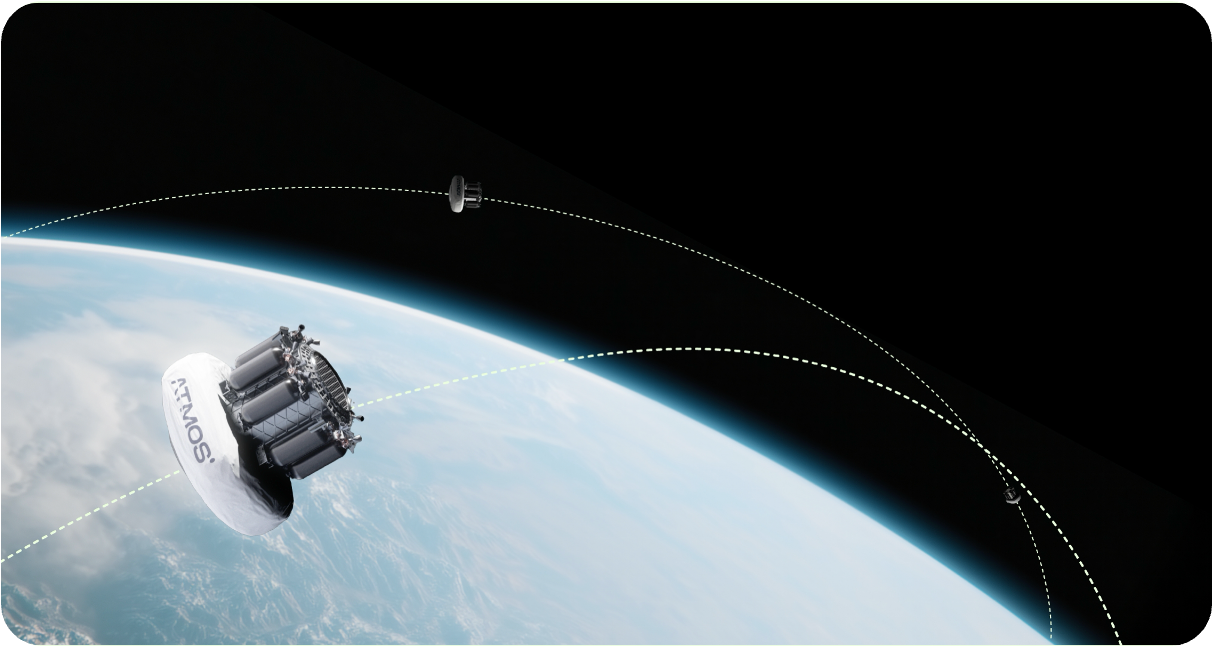
ATMOS WORKS: A Dedicated Entity for European Governmental and Defence Institutions
ATMOS Space Cargo is launching ATMOS WORKS, a dedicated business focused on space logistics and operational capabilities for European governmental and defence customers. The PHOENIX platform’s dual-use architecture supports mission profiles including in-orbit demonstration and validation (IOD/IOV) , secure and sovereign return of sensitive hardware and data, and responsive time-critical operations.
Further details on ATMOS WORKS will be announced separately.
PHOENIX 3: Next-Generation Orbital Return Vehicle Development
ATMOS has begun development of PHOENIX 3, a next-generation orbital transfer and re-entry vehicle designed for a payload capacity of approximately one metric tonne – roughly ten times that of the PHOENIX 2.
The vehicle is being designed to address larger payload classes, aggregated multi-customer missions, and future institutional and security requirements.
PHOENIX 3 is intended to meet the needs of Europe’s evolving space economy, supporting sovereign access to and from orbit, independent technology validation, and the long-term needs of European industry, government, and security users.
Further details on the PHOENIX 3 programme will be announced in the coming weeks.
STATEMENTS
“This financing allows us to move to regular operational service. A structured campaign of three vehicles establishes Europe’s first routine orbital return infrastructure. PHOENIX 2 is the first step to build a scalable European return infrastructure that will demonstrate our ability to access, operate, and return materials, data, and hardware from orbit independently. With ATMOS WORKS and PHOENIX 3, we are building the full architecture – commercial, institutional, and defence-capable – in parallel.”
Sebastian Klaus, CEO and Co-Founder, ATMOS Space Cargo
“ATMOS is building exactly the kind of dual-use capability Europe needs more of: sovereign access not only to orbit, but back from orbit. We believe ATMOS can become a crucial part of the logistics backbone of a real European space industrial base — one built on operational services, strategic autonomy, and the ability to serve commercial, institutional, and defence customers from the same platform.”
Aleksander Dobrzyniecki, General Partner, Balnord
“ATMOS is building a capability Europe critically lacks: a sovereign, repeatable ability to return payloads from orbit. This investment supports the emergence of orbital return as essential infrastructure for Europe’s commercial, institutional, and security needs.”
Ted Elvhage, Founding Partner, Expansion Ventures
“Europe’s strategic autonomy in space depends on sovereign, end-to-end access to orbit, including the ability to return. ATMOS Space Cargo is addressing an important capability gap in Europe’s space infrastructure. This investment reflects the EIC Fund’s commitment to supporting deep tech companies that strengthen European competitiveness, technological sovereignty, and the long-term development of the European space economy.”
Svetoslava Georgieva, Chair of the EIC Fund Board, European Innovation Council