Why we invested in AirHub
This is not a hardware problem. It is an orchestration problem.
When most people think about drones, they think about the devices themselves, range, and sensors. But the real challenge begins once these systems need to operate at scale.
Imagine coordinating hundreds of drones across multiple cities, supporting police operations, streaming live data, and enabling centralized teams to make decisions in real time. What works for a handful of flights quickly breaks down as complexity increases.
Across public safety and enterprise use cases, drones are no longer experimental tools. They are used every day supporting first responders, monitoring critical infrastructure, and enabling informed decision-making in time-sensitive situations. In parallel, new models such as Drone as First Responder (DFR), where drones are automatically dispatched from emergency call centers, are starting to redefine response times and operational workflows.
As deployments expand and automation becomes a reality, a less visible problem emerges.
Coordinating missions across multiple drones, pilots, locations, and regulatory frameworks, while ensuring data security and compliance, becomes increasingly difficult to manage. What works at small scale does not translate to organizational deployment.
Drones don’t scale without a platform
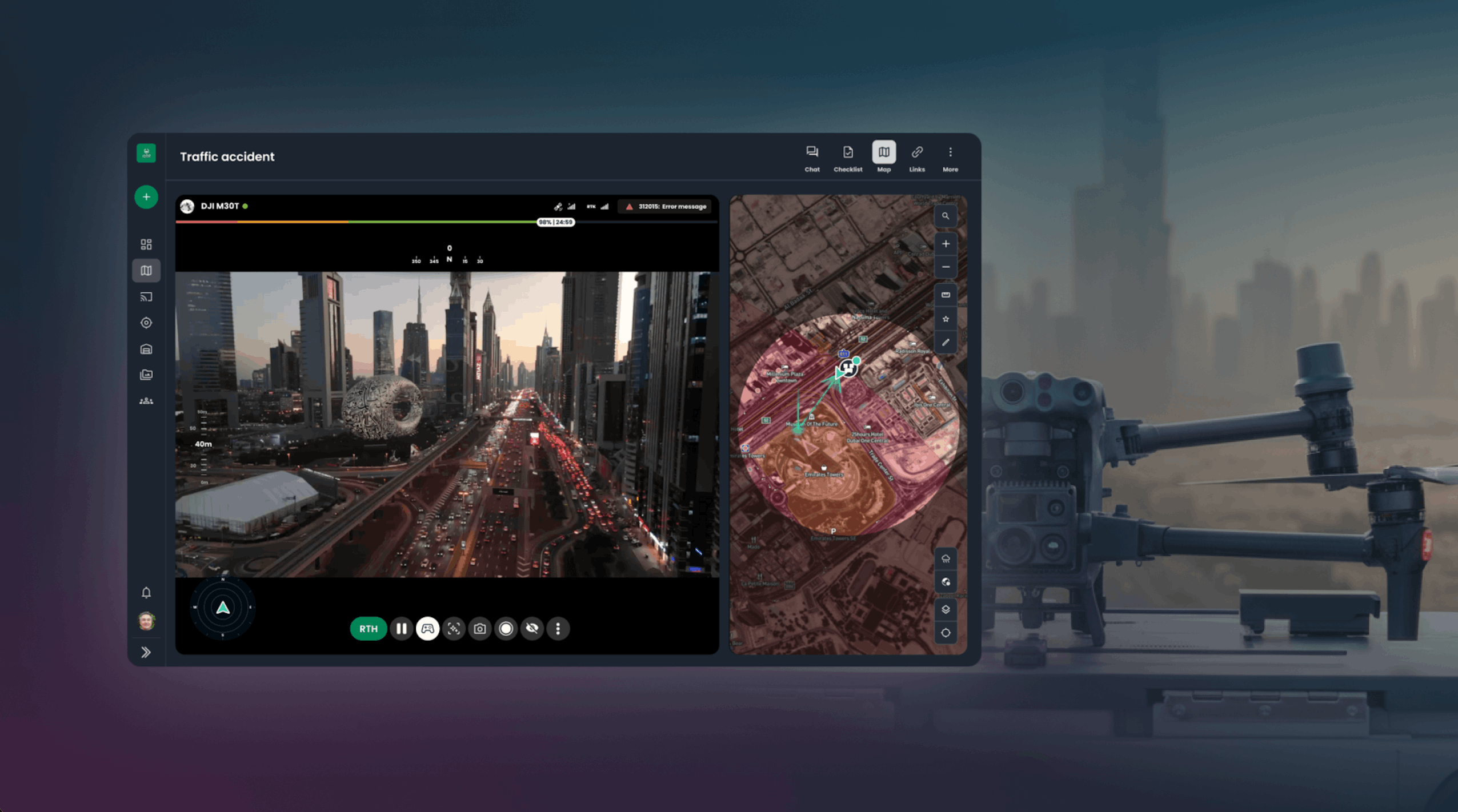
If you think about how traditional aviation operates, the aircraft is only one component of a much larger system: planning, control, communication, and compliance.
Drone operations are moving in the same direction and AirHub is building the layer that connects all.
The platform brings together mission planning, live operations, data management, compliance, and maintenance into a single environment, allowing organizations to run drone programs in a structured, repeatable, and scalable way.
This is particularly critical in public safety contexts, where decisions need to be made in real time, data must remain secure and traceable, and operations must comply with evolving
regulatory frameworks.
More importantly, AirHub does not just improve how drones are used, it goes one level above and enables entirely new operational models. For example, Drone as First Responder (DFR), where drones are automatically dispatched and coordination becomes essential to reducing response times and improving outcomes.
Built for real-world operations
What stood out to us early on was how closely the product is aligned with real operational needs.
Organizations using AirHub are running real, critical missions.
From locating missing persons to supporting large public events, the platform is already embedded in workflows where reliability and usability matter.
In several cases, features such as automated mission logging are not just incremental improvements, they free up security Officers’ capacity, allowing teams to focus on higher-value missions.

Drone operations visionaries
Thomas and Stephan bring a rare combination of technical and regulatory understanding.
With backgrounds spanning engineering, law, aviation and early involvement in drone operations and U-space, they have been thinking about these challenges long before the market fully materialized.
This shows in the product.
AirHub is not built as a collection of features, it reflects a clear vision of how drone operations will need to function at scale.
Looking ahead
We believe drones will become a standard tool across many critical operations. But for that to happen, the underlying infrastructure needs to mature.
AirHub is building a key part of that infrastructure.
We’re excited to partner with the team as they help turn drone operations into something scalable, reliable, and ready for widespread adoption.