Keen Venture Partners publishes practical guide for European defence tech founders navigating Dutch defence procurement
New white paper maps the Dutch Ministry of Defence ecosystem, the innovation-first pathway into COMMIT, and the structural traps that derail founders before they reach a contract.
For a founder with a technically innovative product, European defence procurement is hard to read, even for its participants. The procurement organisations, the people running them, the procurement process, and the project reporting cycle have all been reworked in the last three years, and more change is coming. Add industrial participation rules, security screening, and export controls, and the path from idea to contract is rarely clear. From the outside, it can look like chaos.
Amsterdam- and London-based venture capital firm Keen Venture Partners today released “Surviving Dutch defence procurement: A practical (and surely incomplete) guide for European defence tech founders.” The paper is a working guide for founders asking a single question: “I have a technically innovative idea. What do I actually do in the Netherlands?”
On paper, the Dutch Ministry of Defence should be one of the most attractive defence markets in Europe: the budget has more than doubled in four years, from €12.8 billion in 2022 to €26.9 billion in 2026, with 2% of GDP now a legal floor, 2.8% committed within the current cabinet's term, and 3.5% for core defence by 2035. In practice, the system is difficult to navigate, particularly for startups and new entrants.
The paper walks through how the Dutch defence ecosystem is organised, who decides at which budget level, the innovation-first pathway through MINDbase, ODIN, operational experimentation hubs, and SDIR, and the formal procurement routes under the Aanbestedingswet 2012, the ADV, and Article 346 TFEU. It also sets out three structural risks that catch founders again and again: engaging without a budget holder, mistaking end-user enthusiasm for a buying signal, and discovering security screening too late.
None of this is anyone's fault. European Ministries of Defence are relearning how to grow after decades of cuts, limited political cover, and a security environment that, until Ukraine, did not demand speed. The momentum is real. The processes are still catching up. Founders can't wait years for clarity, and neither can deterrence. The faster procurement gets simpler, the faster the products that strengthen deterrence reach the field.
“Founders default to thinking about pilots as the end of a development cycle, when in the Dutch system they are the start of a procurement cycle. A pilot that doesn't lead to a named budget holder is validation, not revenue.”
The guide is written for founders building dual-use technology in the Ministry of Defence's five strategic focus areas — Intelligent Systems, Sensors, Smart Materials, Space, and Quantum — and for investors trying to judge whether a company has a credible route to Dutch defence revenue. Keen Venture Partners notes that the paper reflects its own interpretation, not an official position, and that the landscape is moving rapidly as the Defence Innovation Authority, Defensienota 2026, and the Wodg and Wwdvgi acts come into force.
This is the first in a planned series. Keen Venture Partners will publish similar guides for other European Ministries of Defence as we work through them. The next instalments will be announced as they're ready.
The paper is surely incomplete. We tried hard to be precise, but we will have missed structures, mislabelled relationships, or misunderstood links. If you can correct us, please do. We'll include it in the next version.
Availability. The full white paper is available on request via keenventurepartners.com and via the link distributed alongside this release.
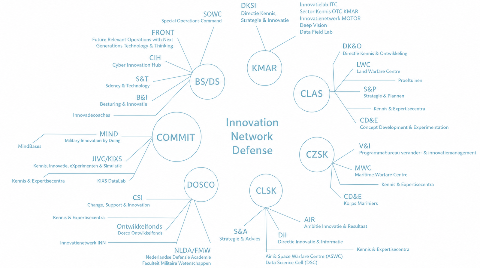
The Dutch defence innovation network
Each circle represents a defence-component innovation function (army, navy, central staff, and so on) with its associated initiatives, labs, and partnerships. Only a handful of these channels are practical entry points for founders, the paper walks through which ones.
The full whitepaper can be accessed here